
A concerning increase in diabetes and the number of patients requiring dialysis has led the government to implement urgent new interventions in Region Six, according to President Irfaan Ali, who addressed the issue during a community outreach on Friday. He described the trend as “deeply concerning,” highlighting the need for immediate treatment support as well as long-term prevention strategies.
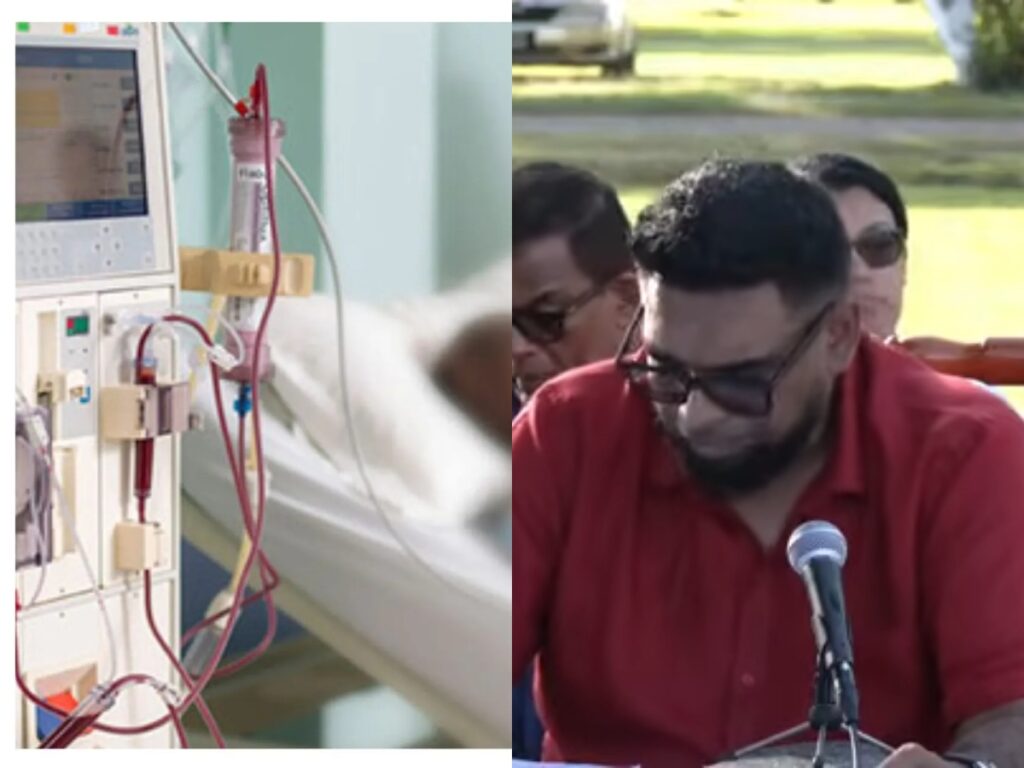
To enhance healthcare infrastructure, the Ministry of Health plans to expand dialysis facilities at hospitals and health centers. However, President Ali emphasized that the primary focus must be on prevention. Community programs targeting diabetes and other chronic illnesses will be launched soon to prevent residents from progressing to the need for dialysis.
In addition to these health initiatives, significant upgrades to the regional health system are underway. The New Amsterdam Hospital is being developed into a level-five facility, with a $1.2 billion state-of-the-art nursing school and multipurpose training center nearing completion, alongside a new $500 million dormitory. The government’s modernization efforts also include a revamped drug distribution system for faster deliveries and new customer service desks at major health facilities, allowing patients to report poor treatment, thereby affecting staff evaluations and accountability.
With large-scale development expected in Region Six, President Ali noted the impending “massive demand” for skilled workers in both technical and service sectors. To address this, the Ministry of Labour will ramp up industrial training programs and enhance recruitment through initiatives like Skills Connect, the Job Bank, and the Central Recruitment Agency. The region hosts one of the most advanced technical training centers in the hemisphere, with a modern hospitality institute scheduled to follow.
Educational reforms are also in motion, with the upcoming launch of the Guyana Digital School, which will provide 24/7 access to learning resources. Nearly 1,000 students in Region Six are already enrolled, with a goal of reaching 5,000 by December. The Education Management Information System will be expanded to all schools, using new analytics tools to identify performance weaknesses and improve outcomes for CSEC and NGSA examinations. Additionally, students will soon have access to engineering and pre-medicine programs locally, reducing costs and enabling them to study closer to home.
Public utilities and infrastructure improvements are concurrent with these health and educational initiatives. Guyana Water Incorporated is investing in new treatment plants, wells, solar systems, and filtration upgrades. Meanwhile, the Guyana Power and Light (GPL) is expanding transmission lines, substations, and distribution feeders. Plans for aviation and maritime improvements include the construction of a new Rosignol International Airport, dredging of the Berbice River, and enhancements in river-safety technology for local fisherfolk.
The Corentyne Highway is also undergoing upgrades, with thousands of new lights, sidewalks, and drainage improvements expected. However, President Ali expressed concern regarding underperforming contractors, warning that investigations and potential legal action could follow. Derelict vehicles along the highway will be removed, and temporary lighting along with stricter safety supervision will be enforced.
Sea-defense issues are a rising concern due to significant mangrove depletion in vulnerable areas. To address this, three kilometers of rip-rap reinforcement will be installed, coupled with enhanced monitoring of salinity levels and coordinated coastal protection planning.
President Ali concluded that all these efforts—from health and education to infrastructure—are designed to ensure Region Six keeps pace with national development. He reiterated that rising diabetes and dialysis cases remain among the region’s most pressing challenges and will be met with a robust, prevention-oriented response.