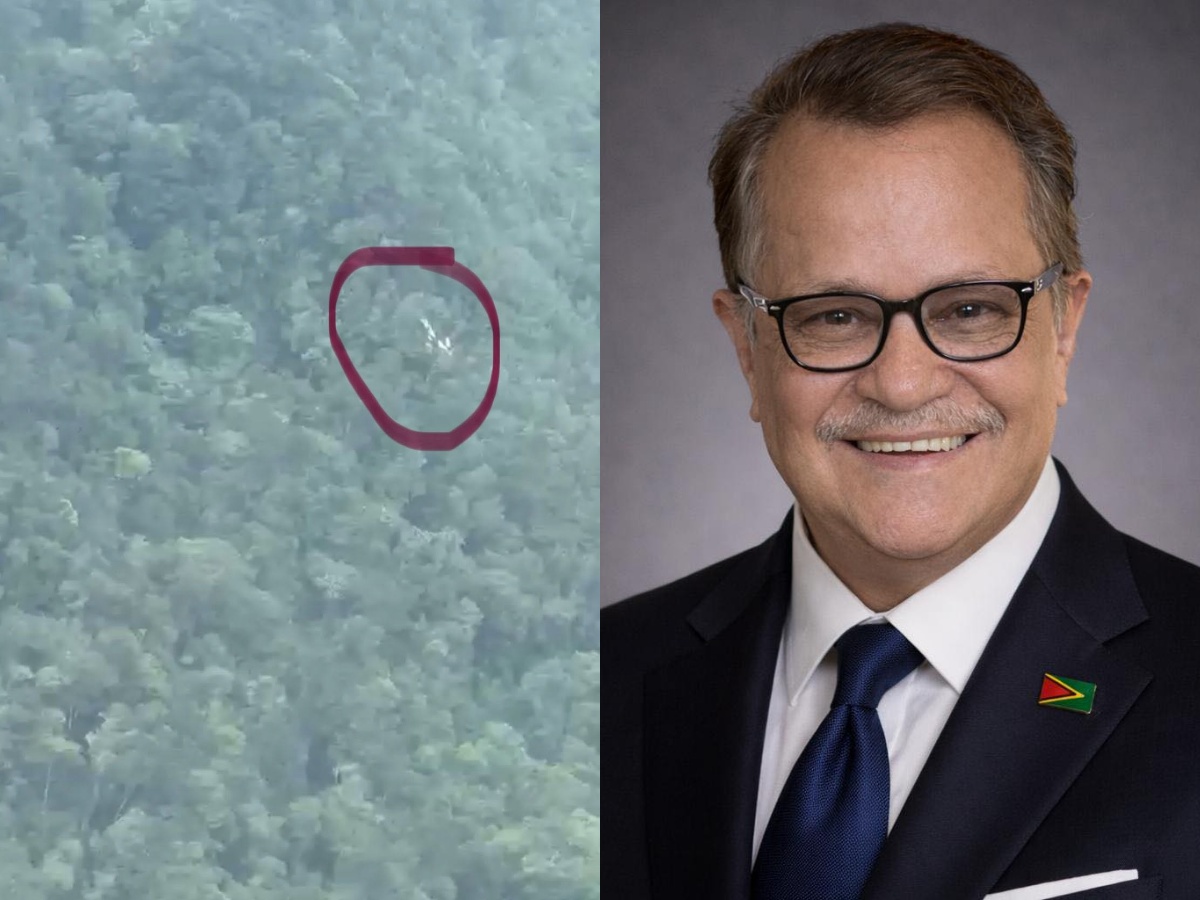
Rescue efforts to reach the crash site of an Air Services Limited Cessna 206 in Region Eight are being severely tested by extreme terrain, dense forest cover, and dangerous flying conditions, as authorities press on with their mission to locate pilot Captain Ryder Castello the sole occupant aboard the downed aircraft.
National Security Advisor Captain Gerry Gouveia has issued a detailed public explanation of the “very real aviation constraints” confronting rescue teams, urging the public to understand the complexity and danger of the operation currently underway near Imbaimadai.
According to Gouveia, the crash site is located on the eastern face of a steep mountain ridge at approximately 4,200 feet above sea level, within a heavily forested and sharply inclined environment that presents severe operational hazards.
“This is not flat terrain it is a sharply inclined, heavily forested environment with limited or no safe landing zones,” he said in a Facebook post on Sunday.
Gouveia further explained that prevailing east-north-east winds create significant risks for helicopter operations, particularly when approaching the eastern face of the mountain, where aircraft are likely to encounter strong tailwind conditions that drastically reduce control margins during hovering or low-speed manoeuvring.
Even advanced aircraft such as the Bell 429 or larger platforms like the Sikorsky S-92, he noted, require stable airflow and sufficient clearance to operate safely conditions that are severely lacking at the crash site.
“The steep incline, dense tree canopy, and proximity of the rock face severely restrict rotor clearance and manoeuvring space,” Gouveia warned, adding that attempting to hover directly above the site would be extremely dangerous with minimal tolerance for pilot error.
He also cautioned that rotor downwash from hovering aircraft could destabilise the wreckage itself.
“The force of the downdraft could cause debris — or even the aircraft wreckage itself to shift, potentially endangering the life of any survivor on the ground,” he said.
Given these constraints, Gouveia said inserting trained ground personnel directly into the area is not merely an option but the safest and most effective method of reaching the site a decision that underpins the deployment of GDF Special Forces to the crash zone.
The National Security Advisor stressed that every decision being made is guided by one overriding objective: locating Captain Castello alive.
“Every decision being made is guided by that objective balancing urgency with the need to avoid actions that could worsen the situation,” he said, describing the operation as high-risk and complex, and calling on the public for understanding and support as rescue teams navigate the formidable challenges on the ground.
The aircraft departed Mahdia on Friday morning and was en route to Imbaimadai when it disappeared. The crash site has since been visually confirmed, with GDF ground forces reporting they have reached a position within visual proximity of the wreckage.
This is a developing story. Updates will be provided as the rescue operation continues.