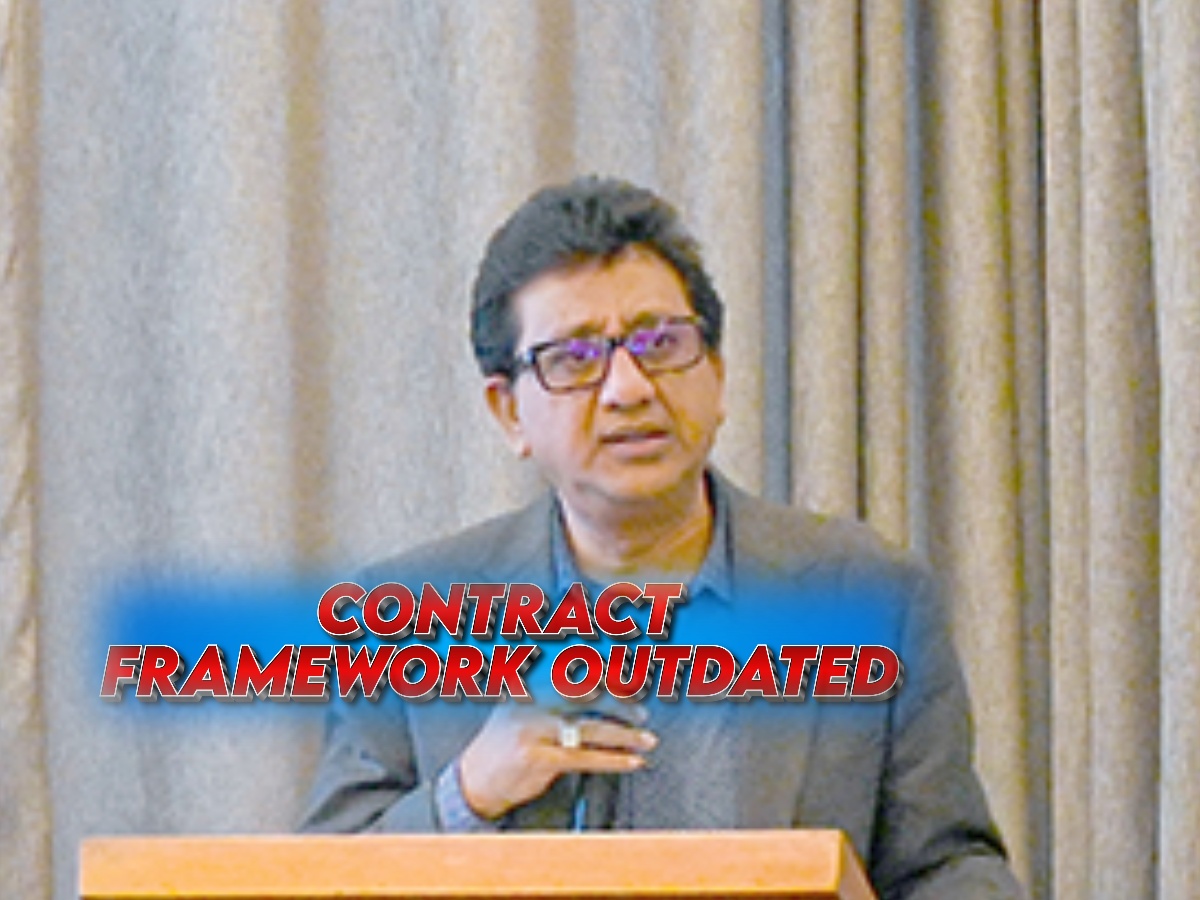
Attorney General Anil Nandlall has declared that Guyana’s existing contract framework is outdated, poorly enforced and structurally weak, and has called for sweeping reforms to bring the State’s contracting regime in line with the demands of a rapidly developing economy.
Speaking at the close of an International Federation of Consulting Engineers (FIDIC)-focused workshop at the Grand Coastal Hotel on Thursday, Nandlall said key elements of the contracting framework — particularly non-FIDIC agreements — are decades old and increasingly ineffective.
“We are using models that are going on to three decades,” he said.
Among the most serious failures he identified is the collapse in effectiveness of financial safeguards such as performance bonds and guarantees, which are intended to secure compliance and protect public funds.
“These instruments… have lost their commercial and financial efficacy,” Nandlall said, noting that rather than functioning as powerful enforcement tools, they have become difficult to activate and unreliable in practice. He acknowledged that government agencies themselves have contributed to the problem by allowing such instruments to lapse during the life of contracts.
“That must change,” he stressed.
The Attorney General also pointed to weaknesses in contract monitoring and supervision, arguing that the system has not been extracting sufficient accountability from engineers and consultants tasked with ensuring compliance. He further flagged caps on liquidated damages and other constraints that limit the State’s ability to meaningfully penalise breaches, suggesting these provisions lack the strength to deter non-performance or delays.
One of his most pointed criticisms was directed at strict notice requirements embedded in contracts, which he said can result in the State losing its right to pursue legitimate claims due to administrative delays or failures.
“I must lose my right to recover a lawful remedy… because an officer failed to serve a notice in time?” he asked, describing such outcomes as unjust and counterproductive, and calling for a rebalancing of these clauses to prevent technicalities from overriding substantive rights.
In response to these systemic failures, the government has launched a parallel review of both FIDIC and non-FIDIC contracts, with the aim of developing updated model contracts, strengthening enforcement mechanisms and building a more robust legal and administrative framework capable of supporting Guyana’s rapid transformation. While FIDIC contracts dominate large, externally financed projects, Nandlall emphasised that the bulk of government work relies on locally funded, non-FIDIC agreements — making reform in that area particularly critical.