








Attorney General and Senior Counsel Anil Nandlall has condemned what he describes as deliberate attempts to delay the extradition proceedings involving businessmen Nazar Mohamed and his son, Azruddin Mohamed. Nandlall emphasized that the filing of an appeal does not automatically halt the case before the Magistrate’s Court.
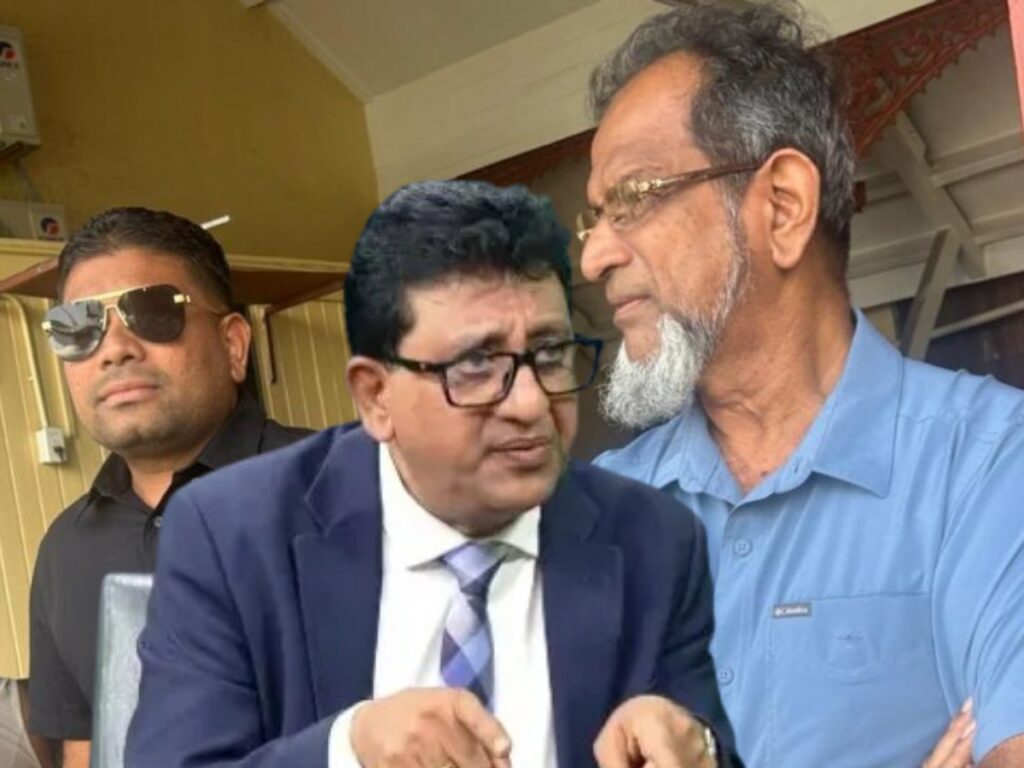
In a media interview on Tuesday, Nandlall addressed the recent announcements from the respondents’ legal counsel regarding the appeal. He highlighted that an appeal does not operate as a stay of proceedings and should not prevent the magistrate from continuing with the committal hearing.
“These are attempts to delay the hearing and determination of the matter,” Nandlall stated, accusing the defendants of strategically prolonging the case—a claim he argued has been acknowledged by one of the respondents and echoed by their legal representatives.
Nandlall pointed out that Senior Counsel Roysdale Forde, representing the Mohameds, recognized in public statements that the appeal does not act as a stay. He asserted that this acknowledgment debunks any expectations that the mere filing of an appeal would halt the proceedings.
According to Nandlall, the legal arguments currently being raised on appeal have already been addressed in the Magistrate’s Court and subsequently in the High Court. He recalled that Acting Chief Justice Navindra Singh previously deemed those arguments “frivolous and vexatious” when rejecting a motion to suspend the extradition proceedings.
“This is a classic case of abuse of process,” Nandlall stated, adding that reiterating the same issues at different judicial levels undermines the orderly administration of justice.
The Attorney General also discussed challenges to amendments made to Guyana’s extradition laws in 2009, stating that these provisions have been in use for years and upheld by the courts. He noted that many individuals have been committed under the same legislation, with similar challenges dismissed in 2018.
“That is the state of the law,” he affirmed. Nandlall emphasized that every judicial officer is obligated to apply the law until it is changed or re-evaluated by a higher court.
Nandlall explained that Guyana’s legal framework operates according to established procedures, asserting that constitutional challenges to committal proceedings should be addressed only after such proceedings have concluded. If a court later determines that the law is unconstitutional, it can quash the committal order, providing the remedy sought.
“What is being attempted here is to turn the procedure upside down,” Nandlall said. “The system cannot be restructured for one or two litigants; the law must apply equally to all.”
He reiterated that the magistrate is within rights to proceed unless a superior court issues a restraining order. Nandlall noted that no stay had been granted and that no application has been filed to prohibit the Magistrate’s Court from continuing.
“The mere filing of an appeal cannot bar the magistrate from proceeding; only a specific order from a superior court can accomplish that,” Nandlall concluded.
On Monday, Acting Chief Justice Navindra Singh denied an application for a stay in the Mohamed extradition case, allowing the extradition hearing to commence before Principal Magistrate Judy Latchman. Substantive arguments regarding the constitutional challenges are scheduled to be heard in the High Court on January 14, 2026.