
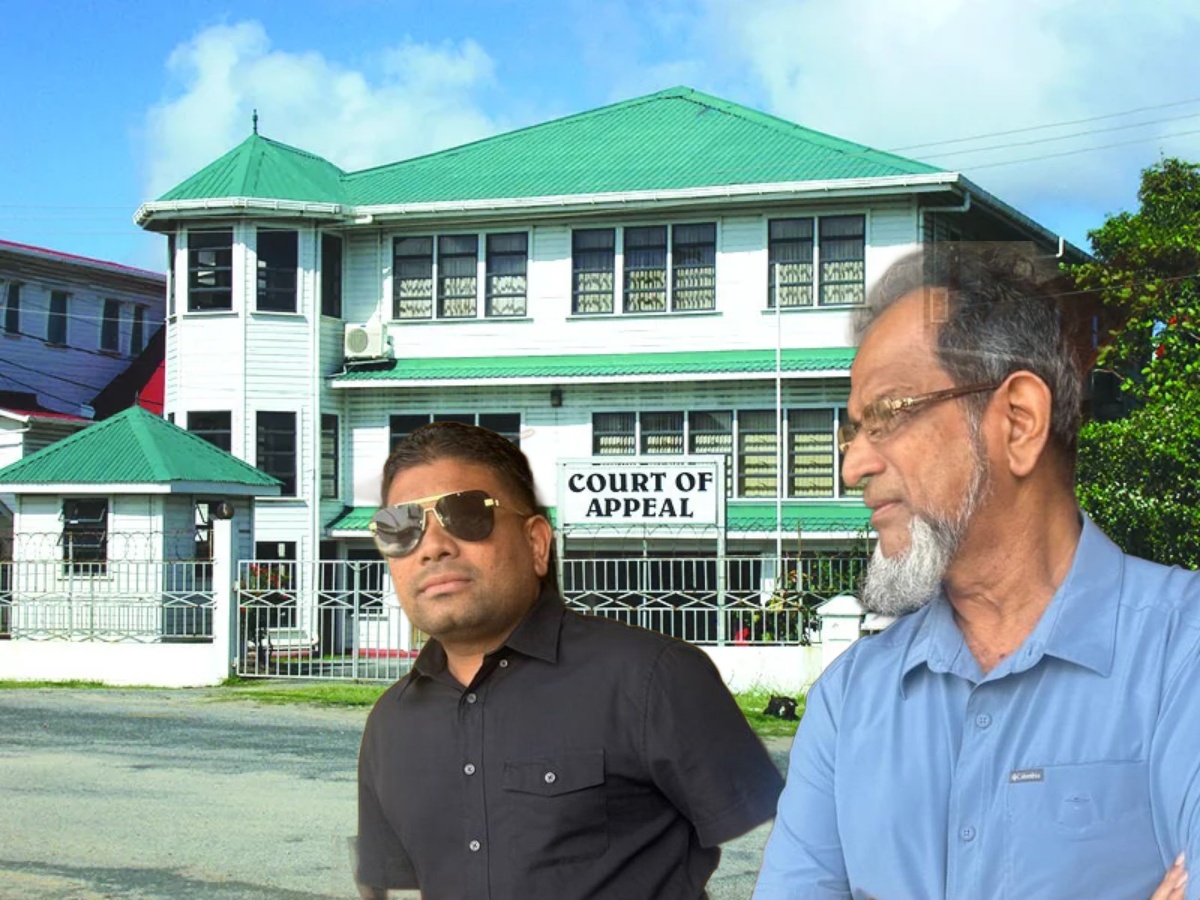
The Guyana Court of Appeal on Tuesday unanimously dismissed the judicial review appeal brought by businessmen Azruddin and Nazar Mohamed, ruling that their challenge to the Authority to Proceed (ATP) in the United States extradition matter had “absolutely no merit.”
Delivering the ruling, Acting Chancellor Roxane George upheld the February 4 decision of Acting Chief Justice Navindra Singh, which had dismissed the Mohamed brothers’ High Court application seeking to quash the ATP issued by Minister of Home Affairs Oneidge Walrond. The appellate court also ordered costs of $1.1 million each to be paid to the Minister of Home Affairs and to the Attorney General. No costs order was made in favour of Principal Magistrate Judy Latchman, who was named a respondent but did not play an active role in the appeal.
The ruling clears the way for extradition proceedings to continue before Magistrate Latchman.
Background and grounds of the challenge
The Mohamed brothers had argued that Minister Walrond was disqualified from issuing the ATP because of alleged political bias. The appellants pointed to Azruddin Mohamed’s status as an opposition political figure and to statements made during the 2025 election campaign, contending those circumstances gave rise to an appearance of bias. They further alleged that legal advice provided by Attorney General Anil Nandlall to the Minister was tainted by the same bias.
Appellate court rejection
The Court of Appeal rejected those arguments in full. Acting Chancellor George emphasised the factual and legal context of the ATP process under the Fugitive Offenders Act, finding that the minister’s role in issuing an ATP is administrative and executive rather than judicial or quasi‑judicial. On that basis, the court concluded that the facts of the case did not give rise to bias.
“There is no evidence that the statutory procedure for issuing the ATP was not followed,” George said, noting that the court found no indication the Minister failed to consider matters required by law before issuing the ATP. She added there was no basis to conclude that the Attorney General’s legal advice could be regarded as biased, stressing that the Attorney General is the government’s principal legal adviser and that supplying advice based on applicable case law and statutory forms is not, in itself, evidence of partiality.
Delegation and practical consequences
The court also dismissed the Mohammeds’ contention that Walrond should have delegated the power to issue the ATP to another minister or official. Acting Chancellor George held that the Interpretation and General Clauses Act and the Fugitive Offenders Act do not support the appellants’ suggested application of Section 27 to compel delegation, nor do they contemplate delegation of the ATP function to another minister or to the Director of Public Prosecutions.
George reasoned that accepting the appellants’ argument could lead to an untenable result in which no minister could act in extradition matters involving a political opponent: “It cannot be the minister or any minister of the government who has responsibility for extradition matters cannot sign an ATP regarding someone who is a political rival,” she said, rejecting such a sweeping consequence.
Preliminary nature of the ATP
The court underscored that the ATP is only a preliminary step in the extradition process and does not determine guilt or whether extradition will ultimately occur. Those determinations remain for the magistrate at the committal stage and for higher courts in any subsequent challenges.
Next steps
The ATP at issue was issued by Minister Walrond on October 30, 2025, following a United States request dated October 28, 2025, seeking the extradition of Azruddin and Nazar Mohamed to face federal indictments. Warrants were subsequently issued, the men were arrested and they later obtained bail pending extradition proceedings.
The Court of Appeal declined to stay the ongoing extradition proceedings. Acting Chancellor George noted that any further application for relief by the Mohamed brothers — including a stay — might more appropriately be directed to the Caribbean Court of Justice if they choose to pursue further appeals.
During an expedited appeal hearing last week, Senior Counsel Douglas Mendes, appearing for the State, argued that the extradition process could not be halted solely because Azruddin Mohamed has since entered politics and become an opposition figure.
The substantive committal hearing before Magistrate Judy Latchman continued on Tuesday and is expected to resume Wednesday as the extradition process moves forward.