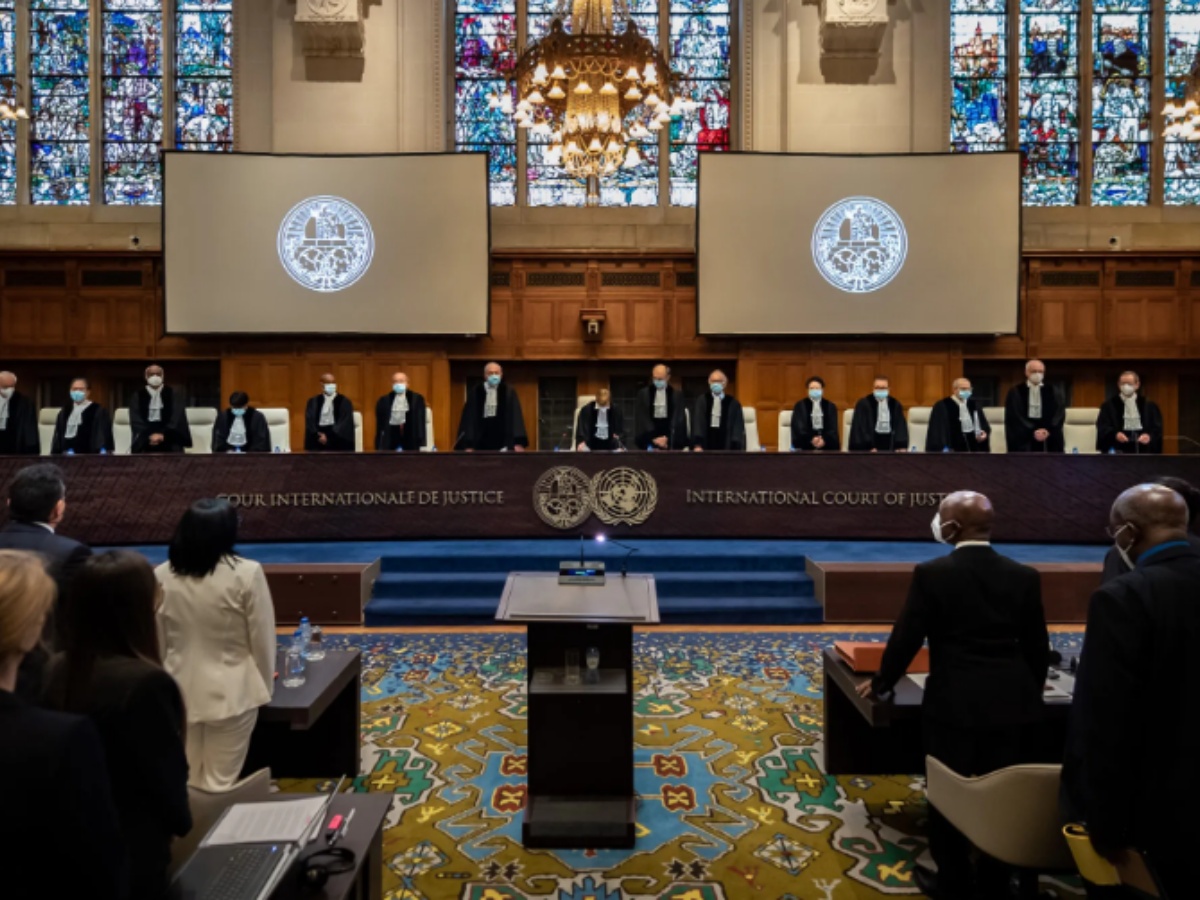
Guyana is set to deliver its second round of oral arguments before the International Court of Justice on Friday in the case brought against Venezuela over the disputed Essequibo territory.
Amid increasing acts of aggression and unfounded claims to two-thirds of Guyana’s territory by Venezuela, Guyana has asked the ICJ to affirm the legal validity and binding effect of the 1899 Arbitral Award which established the land boundary between the two countries.
On Monday, international law professor Dr Nilufer Oral told the Court that Venezuela not only accepted and recognized the 1899 Arbitral Award, but insisted that the Award be implemented to the letter.
In a presentation that delved into the six decades of Venezuela’s consistent acceptance of, and compliance with the 1899 Arbitral Award and the 1905 Boundary Agreement, Professor Oral told the Court that evidence supporting Guyana’s position that Venezuela accepted the Award as “valid and binding” from the moment it was issued on October 3, 1899, is overwhelming.
She said though Venezuela was disappointed that it did not receive a greater share of the disputed territory, it never challenged the legality or the validity of the Award for 62 years.
“Venezuela’s failure to challenge the legality of the Award for 62 years is especially prejudicial to its current claim that the Award is invalid. Each and every one of the challenges to the Award, Venezuela now makes in these proceedings, were available to it since October 1899. Yet, during the next six decades Venezuela did not make any of these claims,” Professor Oral told the Court.
It was argued that while Venezuela now claims that the 1897 Treaty of Washington, which laid the foundation for the Arbitral Award, is invalid, and that the United States and Great Britain had colluded in favor of the latter, it did not give voice to any of those allegations—not in 1897 nor in 1899.
The International Law Professor told the panel of judges led by the President of the ICJ, Justice Yuji Iwasawa, that not only did Venezuela fail to protest or challenge the validity of the Award, it positively endorsed the Award and insisted on strict compliance.
“As much as Venezuela would like to discount the relevance of its conduct during the five-year demarcation period between 1900 and 1905 as merely a technical exercise, the 1905 Agreement is a legally binding treaty that represents years of collaborative hard work between the representatives of British Guiana and of Venezuela which Venezuela willingly and freely signed. As detailed in Guyana’s pleadings, soon after the delivery of the 1899 Award, Venezuela and Great Britain established a Joint Boundary Commission. Now, today, more than one century later, Venezuela would have us believe that it was coerced into participating in the boundary demarcation by Great Britain,” Professor Oral submitted.
Referencing a letter written by Venezuela’s Foreign Minister, Andueza Palacio on March 29, 1900, to the British Foreign Office, Professor Oral said it was Venezuela that had indicated that the demarcation of the boundary was of utmost importance, and that it was mutually beneficial to proceed with it in accordance with the 1899 Award.
Professor Oral asked the Court how Venezuela could now argue that it was forced to engage in the boundary demarcation against its will.
Between 1900 and 1905, the joint Venezuela-British Boundary Commission engaged in the demarcation of the 825-kilometre boundary, and as argued by Professor Oral, there was not a single utterance from Venezuela expressing any objection, reservation, or concern about the boundary being demarcated.
Professor Oral is among a battery of legal luminaries defending Guyana’s position before the ICJ that the 1899 Arbitral Award remains valid and in full effect.
Minister of Foreign Affairs and International Cooperation Hugh Todd, Guyana’s Agent Carl Greenidge, and Director of the Frontiers Department at the Ministry of Foreign Affairs Donnette Streete form part of the delegation addressing the court on the issue.
The Attorney General Anil Nandlall is also among officials present at The Hague.
Once the second round of arguments are completed, it will be up to the Judges to make their decision. That decision is not expected until possibly the end of the year.